New Work on Henricks Art Wall Blends Art and Science
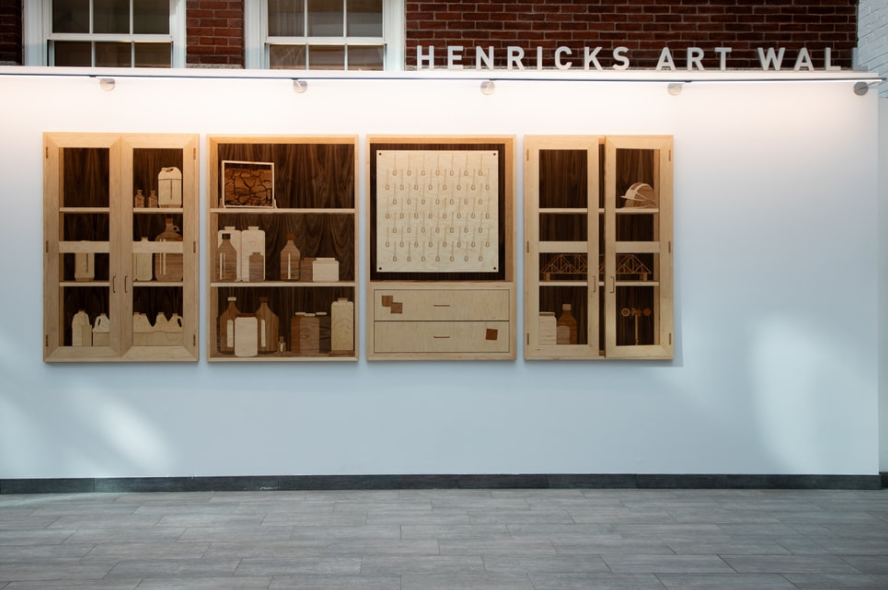
The first floor of the Tsungming Tu Complex looks a little different lately thanks to a new installation on the Henricks Art Wall.
The latest entry is a collaboration between Professor of the Practice Kate Conlon and Part-time Lecturer Boyang Hou, called Xylotheque’s Nocturne. Playing with the concept of cabinets of curiosity, the artists used laser-cut wood inlay to create a modern day “cabinet of curiosity” that depicts objects from lab cabinets around the Tsungming Tu Complex. Their title refers to a specific type of cabinet—a xylotheque— that was used to display collections of wood specimens, alluding to the material used to create the piece.
A peek at the cabinets on the Henricks Art Wall reveals lab coats, beakers, and drills alongside historical lab instruments and natural forms. The artists used seven types of wood and carefully studied the natural grain of each piece to create the shapes and patterns of the objects. The cabinets themselves are created from maple, which is the same type of wood used for the furniture throughout the Tsungming Tu Complex.
Conlon and Hou, who refer to themselves collectively as Limited Time Engagement, were conscious of how the artwork would interact with the surrounding environment. The Henricks Art Wall is located in a busy seating area near the Kindlevan Café where students, faculty, and staff frequently gather to study, eat, or host events. According to the Tufts University Art Galleries website, the artists placed “an emphasis on stillness, allowing the work to be a backdrop for productive mind wandering—a place one can rest their eyes while thinking of something else.”
Xylotheque’s Nocturne is the third installation on the Henricks Art Wall. Previous pieces include Floating Artifacts by SMFA alumnae Evelyn Rydz and Hermit’s Strand by Tufts and SMFA alumnae Kate Costello. The first display featured large photographs of objects that Rydz found washed ashore while conducting coastal field studies. In the second installation, Costello used the archetypal figure of the Hermit to explore how labs and classrooms can serve a similar position of self-removal and provide a space for inquiry and reflection from which to look out onto the world anew.
The Tsungming Tu Complex (originally the Science and Engineering Complex) was constructed in 2017, combining the pre-existing Anderson and Robinson Halls and adding over 47,000 sq ft of new classrooms, labs, and facilities. Among the new additions was the Henricks Art Wall which features newly commissioned artworks by artists affiliated with the School of the Museum of Fine Arts (SMFA) at Tufts. The Henricks Art Wall is generously supported by Joan M. Henricks, J69, and Alan S. Henricks. Xylotheque’s Nocturne is organized by Tufts University Art Galleries.
On May 7, Tufts community members gathered to celebrate the new art installation, which will be on display for the next few years. Those who are interested in learning more about the artist’s process can view a video near the Henricks Art Wall to see interviews with the artists and behind-the-scenes footage of the piece’s creation and installation.
Department:
Biomedical Engineering , Chemical and Biological Engineering , Civil and Environmental Engineering , Computer Science , Electrical and Computer Engineering , Mechanical Engineering